

09 Sep “ALL NATURAL!” Okay… Says Who?
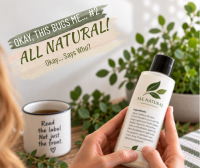
Well, I’m back. Apparently this really is a series now. 😂
Last time I talked about “phthalate-free” and how two little words on the front of a product don’t necessarily tell us the whole story. This week I’m moving on to one that I probably see even more often — “ALL NATURAL.”
It’s everywhere. Soap, skincare, cleaning products, candles, supplements, pet products, food…you name it. Throw those words on a pretty package with a few green leaves and somehow the product immediately feels a little healthier, a little safer and a little better for us.
But here’s what got me thinking about it. What exactly does a company mean when they tell me their product is “all natural”?
You’d think that would have a really simple answer. It doesn’t.
So what does “natural” actually mean?
The deeper I looked into it, the more I realized that “natural” isn’t nearly as black and white as it sounds. What one company considers natural may not be exactly what another company considers natural, particularly once we start talking about ingredients that originated in nature but were then processed before becoming the ingredient that ends up in a finished product.
And honestly, this is something I run into as a maker too. An ingredient can begin with a plant, mineral or other naturally occurring material and still go through processing to turn it into something useful in a product. So where exactly do we draw the line between natural, naturally derived and synthetic?
That’s a much bigger conversation than the front of a label would have you believe.
Then there’s another phrase I see all the time: “made with natural ingredients.” That one always makes me curious because it doesn’t necessarily mean the entire product is natural. A product could contain some naturally derived ingredients along with a bunch of other ingredients, and “made with natural ingredients” can certainly sound a lot more impressive on the front than the full ingredient list might look on the back.
And this is exactly why I’m starting to dislike some of these little marketing phrases. It’s not necessarily because they’re false. It’s because they can give us an impression about an entire product without really telling us very much about it.
Natural doesn’t automatically mean safe either
Here’s where I might surprise a few people, considering the kinds of products I make: I don’t believe that “natural” automatically means safe.
I mean, poison ivy is natural too…and we all know how that can turn out. 😂
Nature makes some pretty powerful stuff, and essential oils are a perfect example. I use them, I love working with them, and I choose them over synthetic fragrance for the products I make. But that doesn’t mean I can pour as much essential oil as I want into something just because it came from a plant.
Essential oils are concentrated. Different oils have different considerations, and some need to be used at very low levels in leave-on products. Some can irritate the skin, and some have specific precautions depending on the oil and how it’s being used.
And the same goes for herbs. Nature gives us some amazing things, but it also gives us plenty of plants, mushrooms and berries we definitely shouldn’t eat, drink or rub all over ourselves.
So when I talk about choosing natural ingredients for Country Herbal Cabin, I’m not trying to tell you that nature equals safe and synthetic equals dangerous. That’s not how I look at it.
For me, it’s about knowing what I’m using and why I’m using it. I want an ingredient to have a reason for being there, and I want to understand enough about it to decide whether it belongs in something I’m making.
And that’s why “ALL NATURAL” bugs me
I actually love natural ingredients, which is probably why this particular claim gets under my skin.
I don’t want “natural” to just be a pretty marketing word.
If I’m looking at something labelled “all natural,” I want to know what that actually means for that particular product — what’s in it, where those ingredients came from and what was done to them along the way.
And sometimes, after looking into it, I may decide I’m perfectly comfortable with it.
That’s another thing I want this series to be about. I’m not digging into ingredients because I’ve already decided they’re bad. Sometimes I look something up and realize my first impression wasn’t right at all. Other times I end up with even more questions than I started with. 😂
I think that’s what has changed for me the more I’ve learned about making products. I don’t automatically trust something because the front says “all natural,” but I also don’t automatically reject something because an ingredient sounds scientific or unfamiliar.
I want to know what it actually is.
So yes, you’ll continue to see me using herbs, clays, essential oils, plant oils, butters and all kinds of other naturally derived ingredients in the things I make. That’s the direction I’ve chosen for Country Herbal Cabin, and it’s something that’s important to me.
I just don’t think slapping “ALL NATURAL” across the front tells me the whole story anymore.
And apparently, I need to know the whole story. 😂
And THAT bugs me.
Next up in Okay, This Bugs Me…
“FRAGRANCE.”
One little word on an ingredient list that can leave me with a whole lot of questions.
Yeah…we definitely need to talk about that one.